
Earlier this year, I got a brief from a Southeast Asian business group. Thirteen executives, seven operating businesses, two half-day sessions scheduled outside operating hours. Get them AI-fluent.
The cohort spanned industrial estate operations, agritech, specialty coffee export, gaming and IP licensing, hyperscale data centre development, energy infrastructure, and venture support. Every executive working on different problems, in different systems, with different data privacy postures. Some were running ChatGPT or Gemini on the side. None were using AI in any structured way for the actual work that took up their week.
This is how I structured an AI workshop for them.
The actual problem the buyer wanted solved
The Head of Projects who commissioned the workshop wasn’t shopping for an AI demo. He was running an innovation function inside a diversified business group. The risk he saw was straightforward: each operating business would figure out AI on its own, badly, in a different tool, with a different data posture, and nothing would be shareable across the group.
What he wanted was simple to state and hard to deliver. By the end of session two, every executive in the room should have a working AI project tailored to their actual job, the literacy to extend it themselves, and a shared vocabulary so they could compare notes across the portfolio.
Two half-day sessions is enough time to do exactly one thing well. So the design constraint was about what to leave out.
The design call
The temptation with executive AI training is to do a feature tour. But that sends everyone home with a buffet of capabilities and no working project.
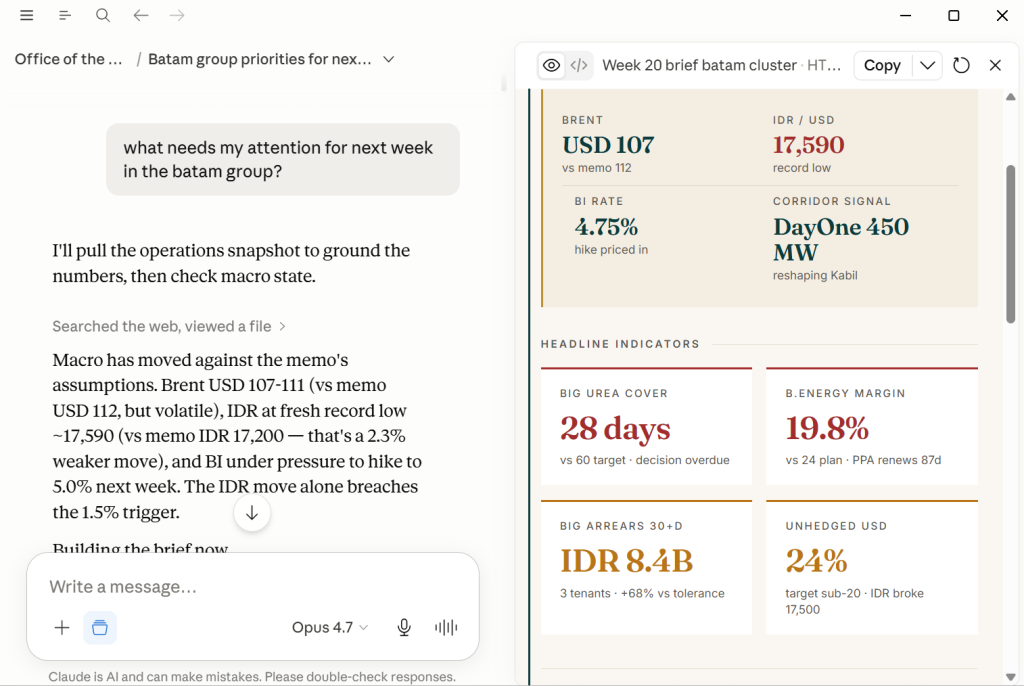
I did the opposite. The workshop opens with a finished product: a fictional Director of Group Operations using their AI assistant to prepare for the week, generating a one-page brief, then a dashboard, then a slide deck, all from short conversational prompts. The macro context was realistic in their context, and verifiable (Iran war energy shock, Brent at 112, the DayOne 450MW PPA signed at Kabil), so the demo felt like work, not theatre. Everything that followed was an explanation of how to build that for yourself.
The pedagogy that follows from that choice:
- Features are introduced as the answer to friction the room just felt, not as a list of capabilities.
- Peer groups coach each other in-room so the facilitator can circulate and harvest patterns for plenary.
- Every group’s project files are mapped to their actual function in the business. One group gets exposure dashboards and a regulatory tracker. Another gets tenant updates, worked examples, and a greenhouse health log. The revenue-facing operators get buyer pitches and content calendars.
This is the part of the workshop that doesn’t scale by accident. The intake work to design four group-specific project packs is the work.
Three things the cohort built
Three projects from the room, anonymised to roles:
The portfolio’s senior legal counsel built a Legal Department Advisor calibrated to her group’s regulatory environment and house playbook. It does first-pass review on EPC contracts, fuel supply agreements, and cross-border commercial contracts. Every output cites the clause, the counterparty, and the exposure.
The director of operations at the venture arm built a Portfolio Health Dashboard. Monthly updates from portfolio companies go in. A portfolio-wide health view comes out, plus a per-founder set of questions for the next review.
The general manager of a specialty coffee export business built a Buyer Pitch Tailor. Buyer profile and target-market data go in. A tailored pitch in the business’s voice comes out, calibrated for North American and European buyers.
None of these are demos. Each one is a working project the executive uses in the week between sessions.
Making the Lessons Stick
Two half-day sessions install literacy. But they don’t install habit on their own. The cohorts that turn the workshop into a permanent shift in how their executives work are the ones where the commissioning sponsor visibly uses AI themselves in the weeks after. The signal “this is how we work now” has to come from the top, not from me.
That’s the reason I keep the WhatsApp group active through the week between sessions and for a month after session two. Most participants need a mid-week nudge, usually a question about why their project is misbehaving or whether a particular use case is worth attempting, to keep momentum. The async support catches those moments and turns them into solved problems before they become abandoned projects.
What this workshop did not provide
During the two half-day sessions, Claude Skills and Cowork get introduced and demonstrated in the room, but participants build them properly afterwards as homework, with the async support that runs through the week. If your team needs those installed by the end of the training with no follow-on work, this training may not be the right format.
These sessions also work best at twelve to fifteen executives. Smaller, and the peer-group dynamic loses its energy. Larger, and the facilitator can’t circulate properly. If your cohort sits outside that range, we’ll discuss a modified format on the intake call.
“Workshop was worth my time, was able to gain a lot of insights into the advanced functionality of how AI works and how it can help me at the workplace.”
– Christian C, Head of Projects
Build Your AI Chief of Staff
If you’re inside a diversified business group with an executive layer that needs to get past the chatbot stage, I run this format under Halfborg Software. Two half-day sessions, group-tailored project packs, async support between and after.


Leave a Reply