

How I used an n8n + AI workflow to turn raw job-site photos and technician notes from a facilities maintenance company into publish-ready B2B case studies in about 90 seconds.
Case studies are powerful, but only if they get shipped
If you work in B2B marketing, you probably already know that case studies are one of your best sales tools.
They beat a generic “Our Services” page every time. Why? Because they mix social proof, a clear story, and real numbers to show exactly how you solve a problem. It’s why 87% of businesses still use them regularly.
Your sales team uses them in proposals. Your performance marketing team uses them in ads. And your SEO manager wants them for ranking on specific search terms.
Yet, ask most marketing teams how many they published last year. The answer is usually, “not enough.”

The real bottlenecks inside a facilities maintenance business
For a facilities maintenance company in Malaysia that fixes things for multi-outlet brands like coffee chains or convenience stores, the problem is even bigger.
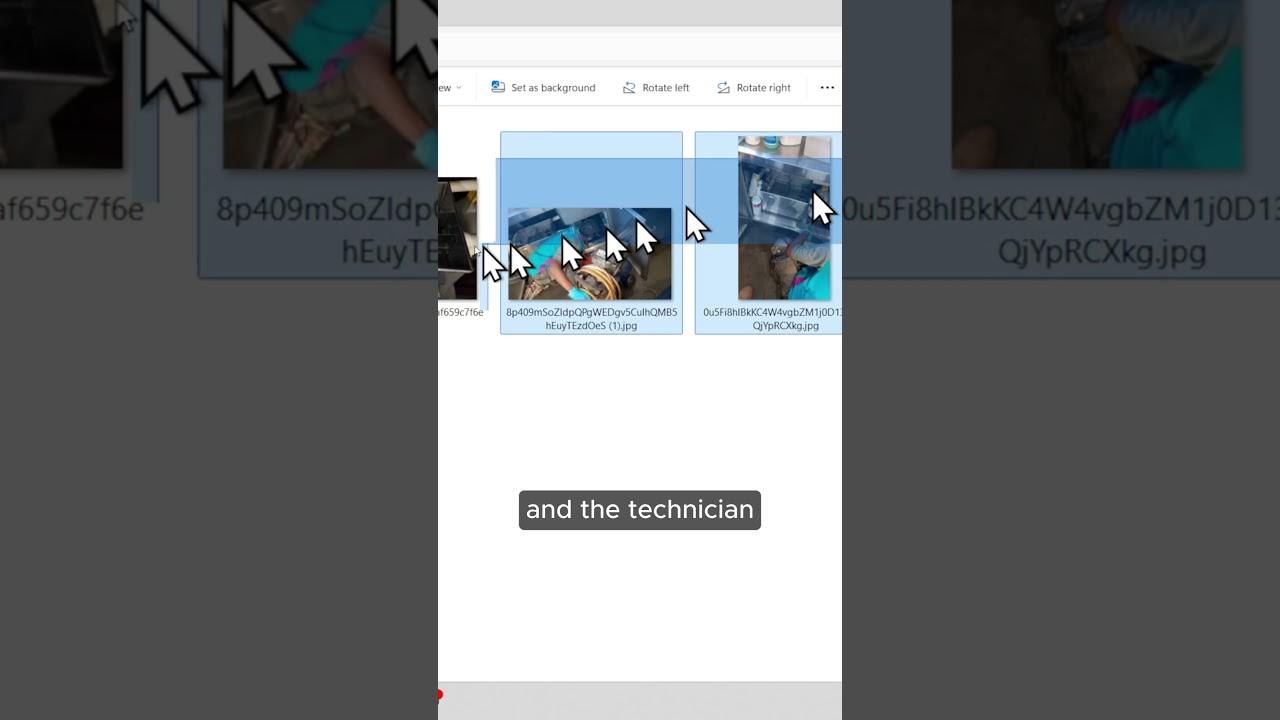
The marketing team is often blocked. They have to interview the technicians to get details and photos about the job. These technicians, they are always busy running from one site to another.
Then, you have to translate the details into a business story that speaks to other potential clients e.g. procurement manager.
When I was a content director, this whole process could take weeks to line up the interview, and then another half a day just to write it.
For facilities maintenance, the opportunity cost is huge
When you do hundreds of jobs a year, but only write about one or two, you are leaving a lot of value on the table. Each job is a small story that shows you are reliable, you have wide coverage, and you know your stuff.
Think about all the lost opportunities. A simple repair at a Nando’s or 7-Eleven outlet never becomes a webpage that can rank on Google.
All those everyday, “unsexy” jobs, like fixing a leaky pipe or a faulty air-con, are the exact things that matter to a potential client worried about downtime.
That kind of content backlog, the opportunity cost is very heavy.
You get fewer pages ranking for search terms like “grease trap maintenance Malaysia” or “multi-outlet facilities management vendor.”
And your sales team has fewer real-world examples to use in their sales decks and proposals.
The Core Idea Behind the Workflow
Treat every completed job as a potential mini-case study
Instead of waiting for a huge, impressive project to write a case study, I decided to treat every single completed job as a potential mini-case study.
Any job that has before-and-after photos and a few notes from the technician can be the seed for a new article. You do not need to wait for the “big ones.”
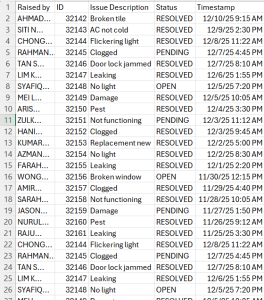
This mindset fits the Recommend.my facilities maintenance model perfectly. We handle many small jobs every day for brands like Zus Coffee, FamilyMart, and Pop Meals. All the basic data, like the location, the problem, and the solution, is already captured in their ticketing system.
So, if we had a real-world example where all we had from the job was a few before-and-after photos and some short notes: “Jalan Ampang café, grease trap slow, blockage cleared.”, could we turn this into a polished case study? That’s what my automation does.
The Workflow
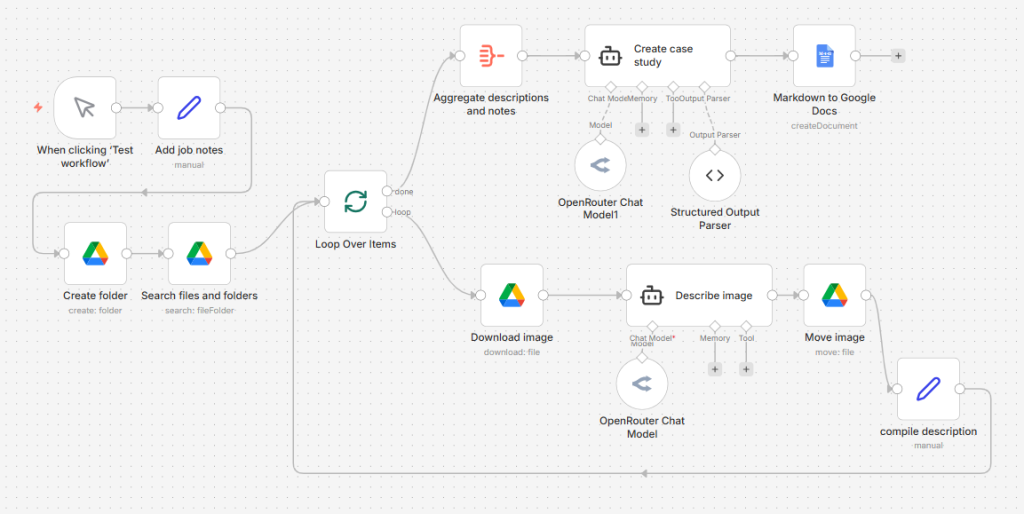
My automated workflow takes those raw materials and generates a case study title and the full article content as a Google Doc, ready for review, with all the job photos organised in the same folder. All in 90 seconds. The time savings is huge.
Now I just need to spend another 10 to 15 minutes on light edits and uploading it to the website. This final step, I still do it myself. It lets me add a final editorial polish, make small SEO tweaks, and add links to other relevant articles on our site. It also allows me to add the right call-to-action for each specific post.
The Tools: n8n, OpenRouter, and Google Drive
I chose these specific tools because they work well together and are easy for teams to adopt.
n8n is the orchestrator that brings the entire process together. It’s a visual workflow builder, so you don’t need to be a top-tier developer to use it. And it connects easily with Google Drive and other online services.
For the AI part, I used OpenRouter. It gives me access to different AI models from various providers. I use one model from Google to understand the images and another from OpenAI to do the writing. This setup means I can easily swap models later if costs change or a better one comes along.
And for file storage, I stuck with Google Drive and Docs. This was a simple choice. The operations and marketing teams were already using them every day. It’s better to keep the final output where people are already working, instead of making them learn a new tool.
The key steps in the workflow:
- Retrieve job site photos from a dedicated Google Drive folder
- Send the images to an AI vision model to describe the images
- Aggregate all image descriptions into a single job narrative
- Generate the full case study article in markdown with a language model
- Turn markdown into a formatted Google Doc and tidy up files
Time savings and throughput increase
So, what was the actual impact of this new workflow? The numbers are quite dramatic.
My old manual process took around four hours for a single case study. That included all the back-and-forth for information, the writing, the editing, and the formatting.
The new semi-automated process gets the first draft and all the file organisation done in about 90 seconds. After that, it takes me just 10 to 15 minutes to do a light edit and publish it on the website.
This completely changes the output capacity of the marketing team.
If you have just two or three hours a week for content, the old way might get you one case study published, if you are lucky. With this new workflow, you could easily publish five to eight case studies from jobs that have already been completed.
If our facilities maintenance division completes 300 relevant jobs in a month, and we turn just 10% of them into case studies, that is 30 new pieces of high-quality content. Before, that would have been impossible.

SEO and content footprint benefits
This increase in volume has a huge benefit for our website’s SEO.
Each case study can target very specific, long-tail search terms. Think about what a potential client might actually search for.
Instead of just ranking for “facilities maintenance,” we can now rank for things like “grease trap maintenance Jalan Ampang” or “cafe grease trap slow drainage Malaysia.”
Every new case study also becomes an opportunity for internal linking. We can link from the case study back to our main service page for plumbing, or our category page for air-con services. This helps Google understand what our website is about.
The expected outcome is a much larger digital footprint. Over a few months, we will have more pages indexed on Google, get more organic traffic for specific maintenance queries, and build more trust with procurement teams who can see dozens of real job examples.
Sales enablement and operations benefits
The benefits go beyond just marketing.
Our sales team now has a constantly growing library of fresh examples. When they talk to a new prospect, they can pull up a case study that is directly relevant to that prospect’s industry, whether it is a cafe or a convenience store.
The operations team also benefits. These case studies act as a narrative log of interesting or complex jobs. They can be used as training material for new technicians or account managers.
And finally, it changes the perception of our brand. It shows that we reliably handle the everyday, “unglamorous” jobs that are critical for our clients’ operations. It positions us as a data-driven, tech-enabled partner, not just another vendor.
Want to set this up for your marketing team?
If this sounds like your company, I can help you build a similar system.
I offer a marketing technology consulting service where we can map out your current job or ticket workflow. From there, we can design an AI-assisted content pipeline that fits right into it.
The final step is to build the n8n workflow that connects all your existing tools.
You can find out more about what I do at halfborg.com




Leave a Reply