

Writer’s block used to hit our content team almost every week at Recommend.my and Sejasa.com. The problem was never the people. It was the calendar.
A social media page is hungry. It wants something new every day (or several times a day). And no matter how big the team got, there were always days when nobody had the time, or the idea, to feed it. Someone would open a blank draft at 4pm, stare at it, and close it again.
If you run a small business, you know this feeling. More than half of small business owners have an hour or less a day for all of their marketing. Content is usually the first thing that gets pushed to “later”. And later never comes.
You already have tomorrow’s posts. You just haven’t made them yet.
The thing that changed for us was a small shift in how we thought about content.
We stopped treating content as something we had to invent from nothing. We started treating it as something our business was already producing every single day, as a by-product of the actual work.
Think about what a normal day generates. A customer leaves a five-star review. A technician finishes an aircon servicing job and snaps a few photos. A piece of local news breaks that your customers care about. Each of those is a post, sitting there unused.
So the question stopped being “what should we post today”. It became “how do we turn what already happened today into a post”. That is a far easier question to answer, because the raw material is already there. You just need a system to process it.
How the content engine works
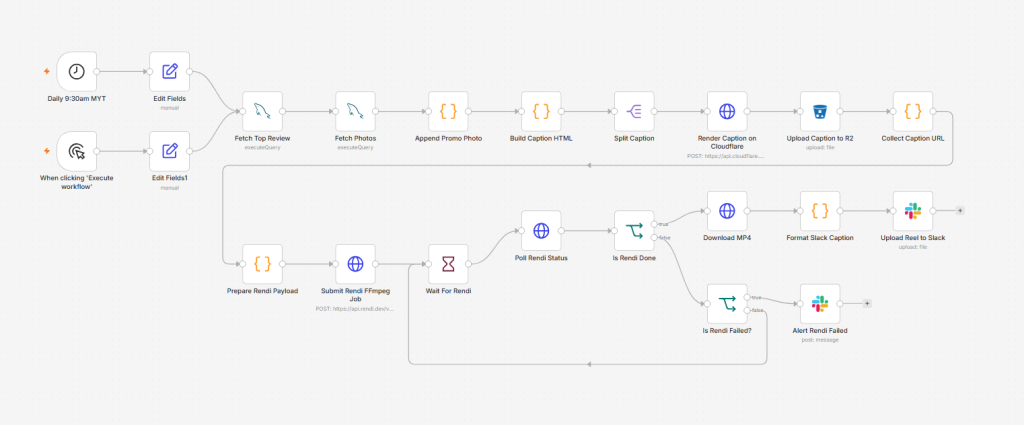
I built that system in n8n, the automation tool we use for most of our internal workflows. Today there are 9 separate content automations running daily (and the number is growing). Each one takes a specific type of raw material and turns it into a draft.
A few of the workflows that run:
- Yesterday’s best five-star review becomes a Facebook and Instagram album.
- A completed aircon servicing job becomes a short video reel, built from the job photos and clips.
- Trending local home-improvement news becomes an image post.
- A maintenance job for a corporate client, like a cafe chain or a convenience store, becomes a written case study. That one has its own full walkthrough in automating case study articles for a facilities maintenance company.
None of these are complicated on their own. The pattern is always the same. Take one kind of raw material, pass it through a workflow that knows how to format it, and produce a draft. Repeat that for nine kinds of material, and by lunchtime my team has up to 9 drafts waiting for them.

The system drafts. A human still decides.
Every draft lands in a Slack channel, where a real person on the team reviews it, edits it, and schedules it out to Facebook, Instagram, TikTok and YouTube.
That matters for a few reasons. First, quality. AI drafts are a strong starting point, but they still need a human eye to catch the ones that are off-tone, factually loose, or just not good enough to represent the brand. Second, trust. Customers can tell when a page is running on autopilot with nobody home. A human in the loop is how you get the speed of automation without the soullessness. The system removes the blank page. It does not remove the judgement.
But, this system only works if your business actually generates raw material every day. We do hundreds of jobs and collect reviews constantly, so there is always something to convert. If your business has quiet stretches where genuinely nothing happens, the engine has nothing to feed on, and you are back to inventing content from scratch.
And it does not replace your team. Switch off the human review step to save a bit more time, and the quality drops fast. The automation buys your editors time. It does not do their job for them.
What it did buy us was consistency. Nobody on the team starts the day with a blank page anymore. We publish something new daily no matter what, and the editors spend their good hours on the work that actually needs a human, like featured stories, interviews and proper research that a workflow could never produce.
What raw materials does your business have?
Your operations are already generating content. The gap is just a system to catch it and shape it into something you can post.
How are you keeping your own social pages fed right now? Are you inventing posts from a blank page every week, or have you found a way to pull them out of the work you are already doing? If you want a system like this running in your own business, that is the kind of thing I build. You can see more of my work at halfborg.com.




Leave a Reply