
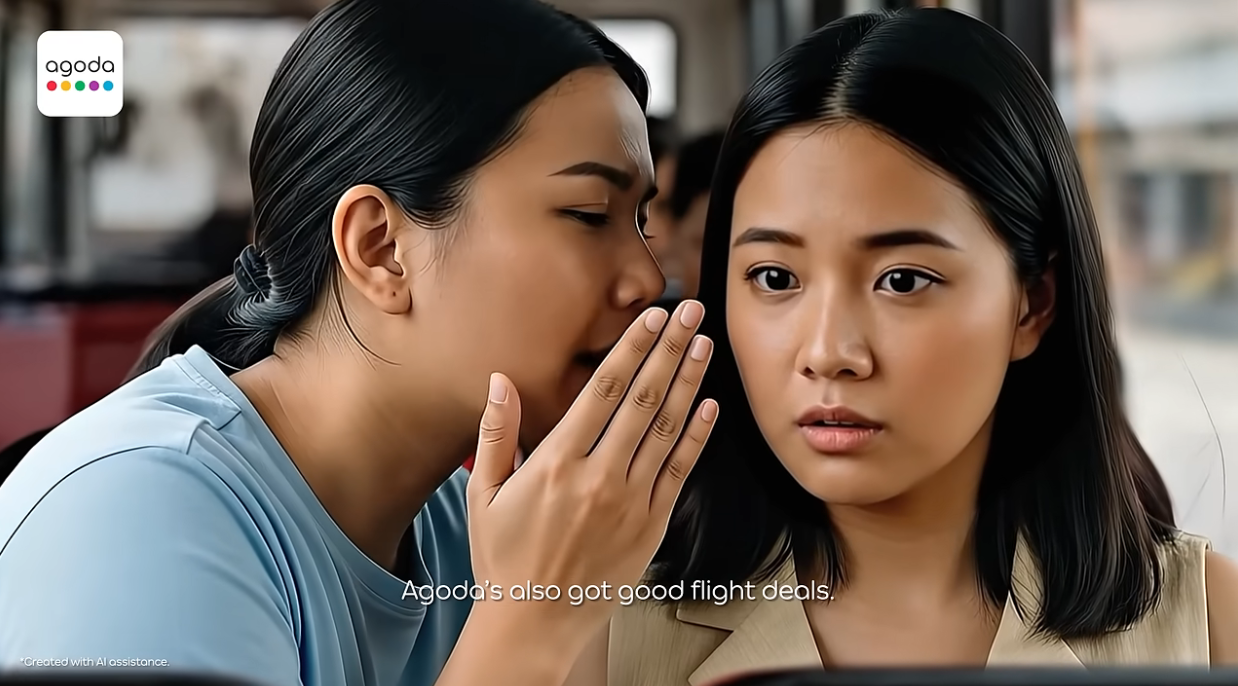
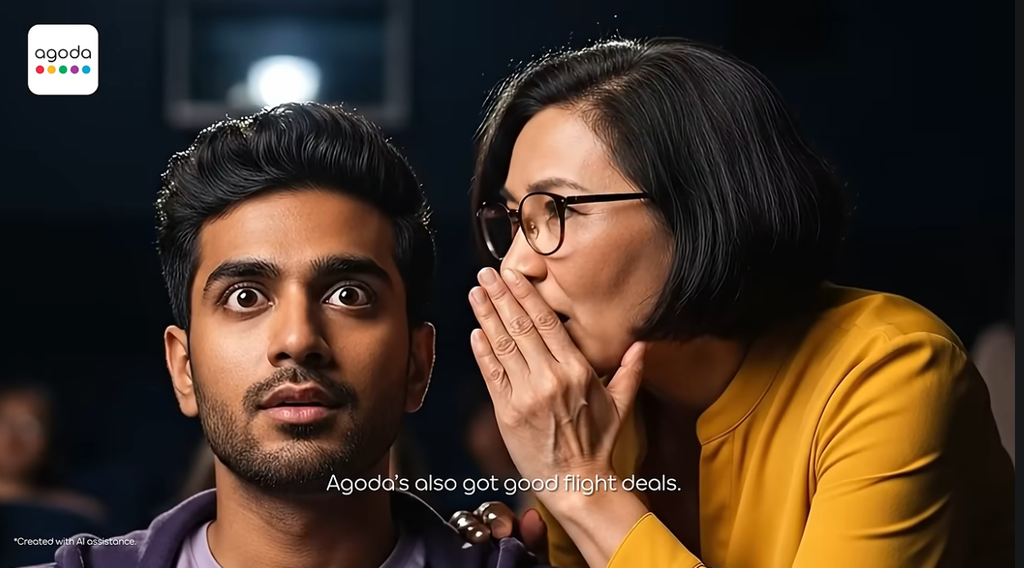
Have you seen the Agoda ads on YouTube? The one where the friend whispers in the ear. Or the one with the guy in sunglasses and a pool float.
Everyone I mention it to says the same thing. You can tell it’s AI in the first second.
Agoda did not hide it. Their own press release calls it an AI-powered commercial. Every visual was made with Veo, Runway and Kling, and only the idea and the voice-over were human, according to Marketing-Interactive.
But you didn’t need a press release to tell it was AI. It’s ultra clear just by looking at the faces.
More using AI images, but less doing actual review
In July 2024, MOF posted an AI image of a “lower-income couple”. Netizens found a translucent sixth finger and too many teeth, and called it “scary” and “looks like a scam ad”. Granted, this was early days of Midjourney and Stable Diffusion going mainstream.
In July 2025, Agoda ran the campaign that I mentioned earlier, on YouTube, Meta and TikTok.
In July 2026, Kampong Chai Chee CC put up National Day banners in Bedok with distorted figures, malformed hands and a flag missing its crescent and stars. They came down the same day, and AsiaOne reported netizens calling it “AI slop”.
The problem is not that it’s AI
You might think the lesson is “don’t use AI in ads”. But that’s not changing anytime soon. Google Ads already lets you generate new images as you are creating your ad campaign, for free. And Meta does the same.
So, generate them if you like. But make sure to review the output carefully. Or else others will review it for you, and call you out.
DoubleVerify’s 2026 APAC report, reported by Marketing-Interactive, found that 47% of Singapore consumers say a low-quality AI-generated ad would make them think less of the brand. Only 25% viewed it positively.
But for professionally produced AI ads, the same survey showed that just 18% said it would hurt their view of the brand, and 45% said it would improve it.
So, people are fine with AI ads. They are not fine with bad ones. AI ads have taken off because they’re cheap and fast to make. But that speed is the also the trap. Because nobody stops to get the faces right.
Faces are getting less creepy on their own. But now they all look the same.
If you look at the timeline of recent AI image generation, they were dominated by a specific flaw. 2024 was six fingers and weird teeth. 2025 was glossy faces. By 2026 the models mostly draw hands and skin properly on the first try.
So the creepy phase is ending. Give it another year and nobody will spot an AI face from the skin.
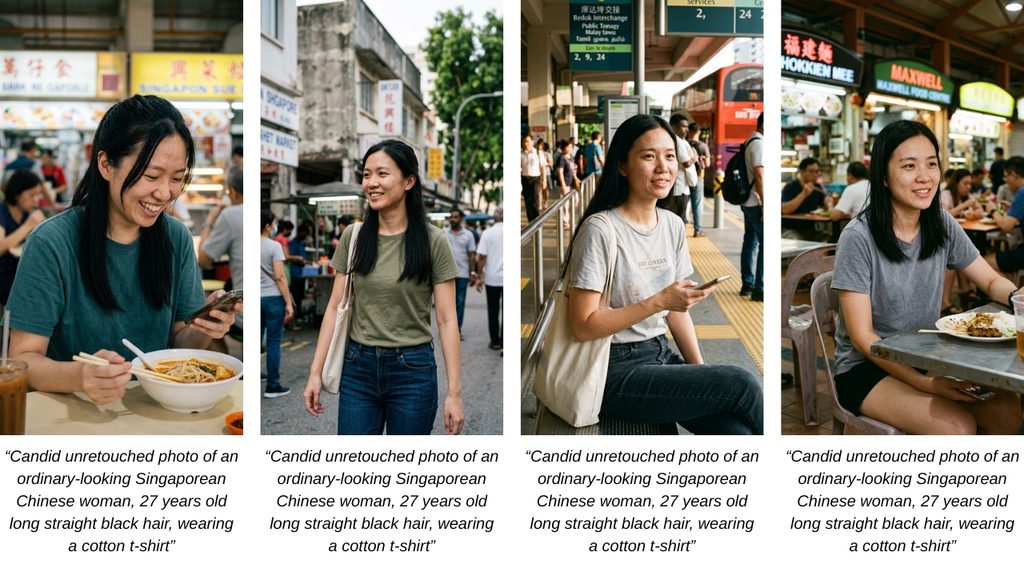
But, the problem now is that every AI character looks the same. Prompt for a “Singaporean woman” in Gemini and you will get the same character over and over. Same age. Same face. Same smile. Same setting. See images below.
So, it’s not an uncanny valley image, but it’s a face that has probably been generated by everyone else, and use in every other ad.
Why every AI person has the same face
To get the images above, this was my prompt:
“Candid unretouched photo of an ordinary-looking Singaporean Chinese woman, 27 years old long straight black hair, wearing a cotton t-shirt”
This prompt defines the ethnicity, age, hair and t-shirt. But for everything that we did not define, the AI filled in the blanks with whatever it thinks is most likely.
So, it say “Singaporean” so it set the scene at a stereotypical Singaporean location; a hawker centre, a bus stop, etc.
But, a real photo has much more variety than that. The type of camera, the place, the lighting, the features. The generic prompt has none of that. So the AI model fills the gaps with its average, and its average looks like a stock photo.
It’s like going to a restaurant and ordering “food”. You’ll get something. But it’ll be the safest thing on the menu. And it’s the same dish every time you order.
That is the whole sameness problem in one line. The average is one face. A better model draws that one face with better skin. It doesn’t give you a second face.
So, what you need to do is add more details in your prompts. But that’s a drag when you just need a random person who could look like they exist in Singapore. And one who is not a model in a skincare advert.
A free tool to generate randomised prompts of ordinary Singaporeans
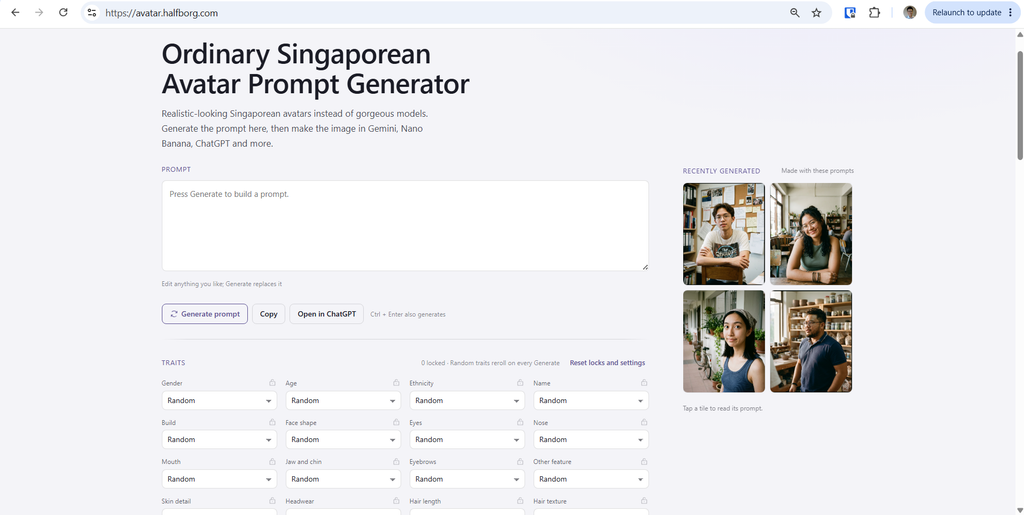
So, I built avatar.halfborg.com to write that prompt for you. It’s an ordinary Singaporean avatar prompt generator, which is a long name for a short idea: every press of Generate describes one specific, ordinary person who could be sitting at the next table.
To keep it niche and specific, this tool only covers Singaporean Chinese, Malay, Indian and Eurasian faces, plus neighbours from Malaysia, Indonesia, the Philippines, Thailand and Vietnam, in a variety of places and not just hawker centres, void decks and HDB flats (though those are there too).
If you don’t set anything, the tool will pick the gender, age, the build, one distinguishing feature, the skin, the hair, the clothes, the expression, the pose, the setting, the light and the camera, and leaves out the words that summon the glossy look.
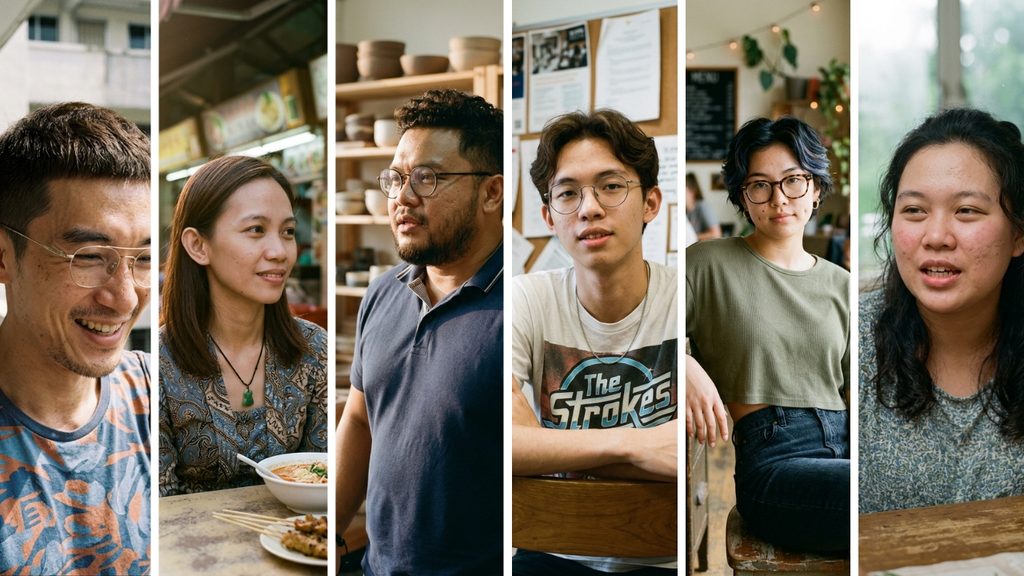
When you try it the first time, leave every dropdown on Random and press Generate. Press it again and you get a different person, not the same person in a different shirt.
Lock the traits you want to keep (the shirt, the setting, the age) and randomise the rest. That’s how you get a cast for one campaign: six people who belong in the same ad and are still six people.
Every result shows a seed, so you can bring back one you liked. The prompt box is editable, so you can change the ethnicity or the setting for a market outside Singapore, and there’s a prefix and suffix you can change if your model wants different framing. Then copy the generated prompt to your favourite image generator e.g. Flux, Nano Banana, Stable Diffusion, SDXL, Gemini, ChatGPT or others.
It’s free and runs entirely in your browser.
A useful starting point
My tool writes prompts for still portraits. You can then take the images and create your ads. You can follow the keyframe workflow from my home repair video ad.
Of course, it’s always important to check the output before the AI character goes into your ads. Remember to look at:
- Symmetry. Real faces aren’t symmetrical. If both halves match, it reads as fake.
- Skin. No pores and no texture is the skincare-advert tell.
- Lighting. Real light comes from somewhere. Even light from everywhere does not.
- Hands. Count the fingers. Bedok and MOF both failed here.
- Sameness. Put your last five AI people side by side. If they look like cousins, it’s the prompt, not the model.
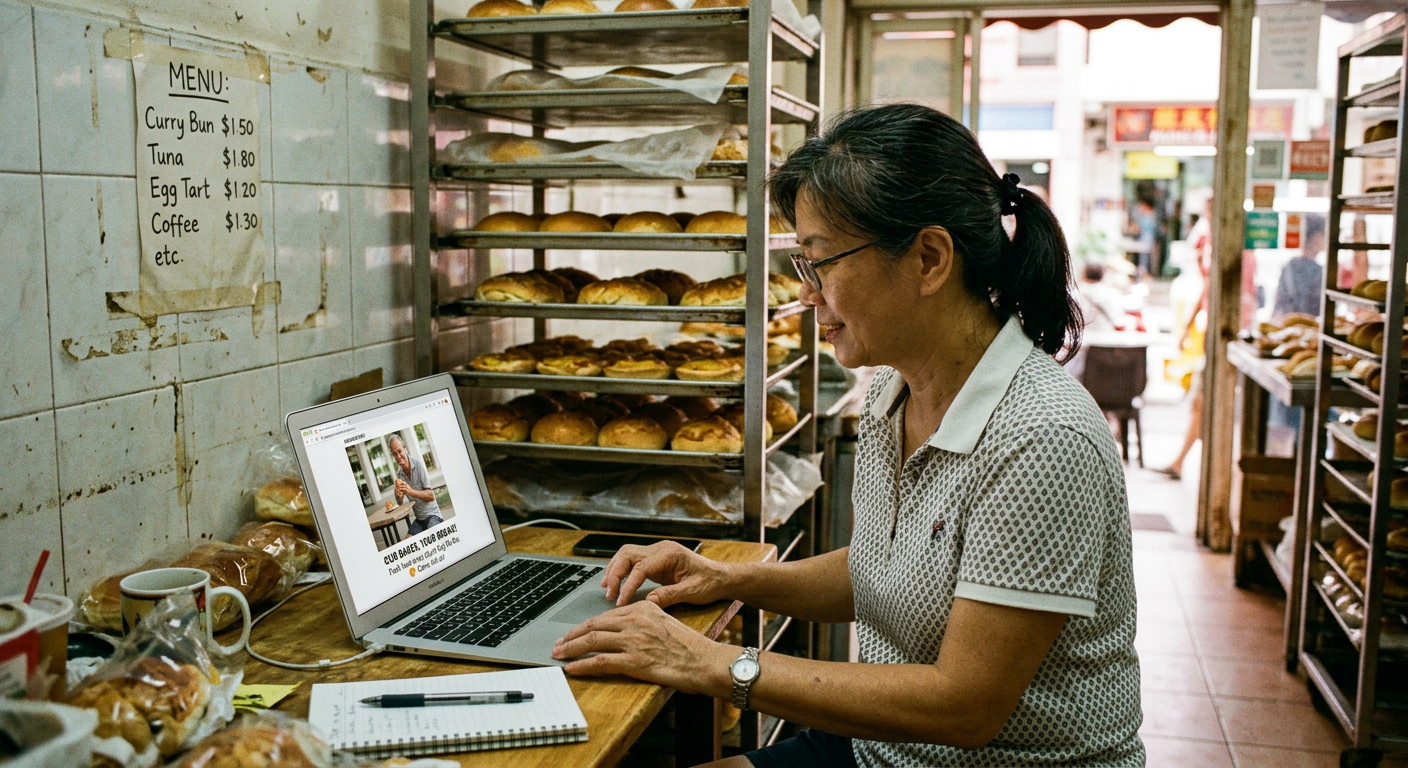
If you run a small business and make your own ads, you are going to use AI people. That’s fine. But make them look like people who live here. And make them look like different people.
That’s why the Agoda ads looked creepy. It was the face. The next batch of AI ads won’t look creepy. But if you don’t write your prompts well, they’ll still look like each other.
Try avatar.halfborg.com for your next ad!
PS: Tell me: which Singapore AI ad made you cringe?




Leave a Reply