
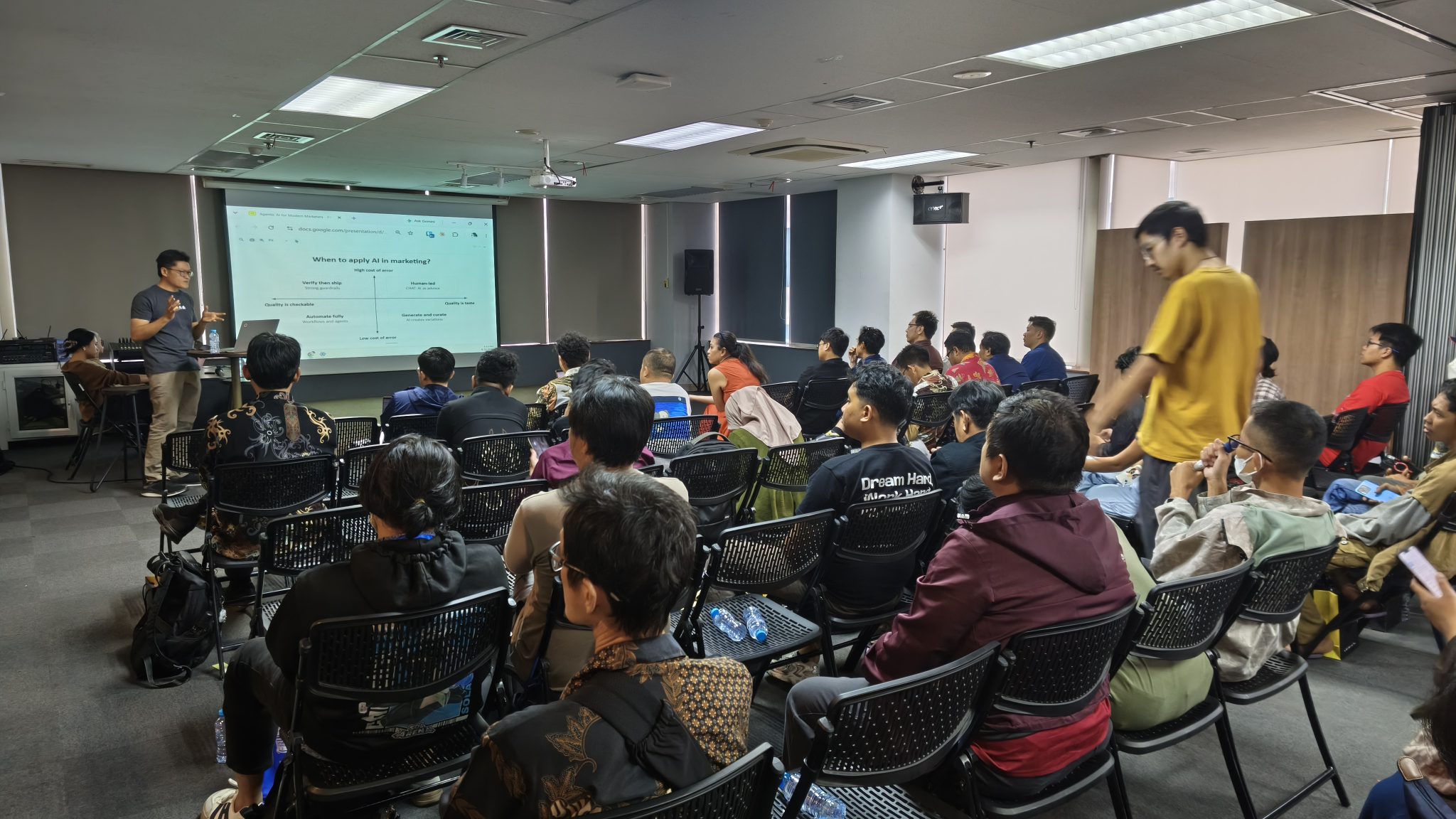
The following is from a talk I gave at Block71 Jakarta in August 2026 about using Agentic AI in Marketing.
As a marketer, you probably use AI to generate images and write copy. But what about planning entire campaigns, or producing marketing ops reports, or finding inspiration and ideas?
To understand “which AI to use and when”, you need to first understand the difference between an AI chat, workflow and agent. So here’s an example to illustrate this:
Imagine that your kitchen is on fire. The smoke alarm is going off. You grab your phone and ask the AI what to do.

It tells you: "Ambil pemadam api di bawah bak cuci." (Take the extinguisher from under the sink). Pull the pin. Aim at the base of the flame, not the top. Then get out.
So, the AI above gave you a response. But you still have to take action i.e. find the extinguisher, pull the pin and run. That is AI chat.
Ok let’s look at another example:
Now imagine the same fire, but this it triggers a smoke alarm. Which kicks off a series of events:

The CCTV in the kitchen switches on. An AI looks at the camera image to work out what is burning. If it's wood or paper, it triggers the water sprinkler. Oil or electrical, it triggers CO2. At the same time, an alert goes to the fire department and your phone buzzes.
Everything above started from a single event. But everything was also planned in advance. Someone wired the alarm to the camera, the camera to the AI, and the AI to the extinguisher system. In the process, the AI was asked to make one decision: what is the source of the fire. That is an AI workflow.
Now a final example:
One more fire. Same alarm.

This time the AI checks the CCTV and sees the fire is coming from the new electric kettle you bought last week. It calls the fire department, then unlocks the front door when the truck arrives. It sends a drone in to carry the cat out. Then it leaves a 1-star review at the shop that sold you the kettle.
Nobody wrote a rule about the cat. Nobody wrote a rule about the front door, or the review. All the AI had was an objective: protect the lives in the building. It worked out the rest. That is an AI agent.
You don’t have to pick just one
So, which one should you use? The answer is any of them, and all of them.
Across my own businesses, I use a mix of chats, workflows and agents to produce 25 different kinds of marketing output across 7 functions, from blog posts and case studies to ad scripts and weekly reports. Some of it is chat. Most of it runs on around 120 n8n workflows. A small but growing part is agents running on this plugin.
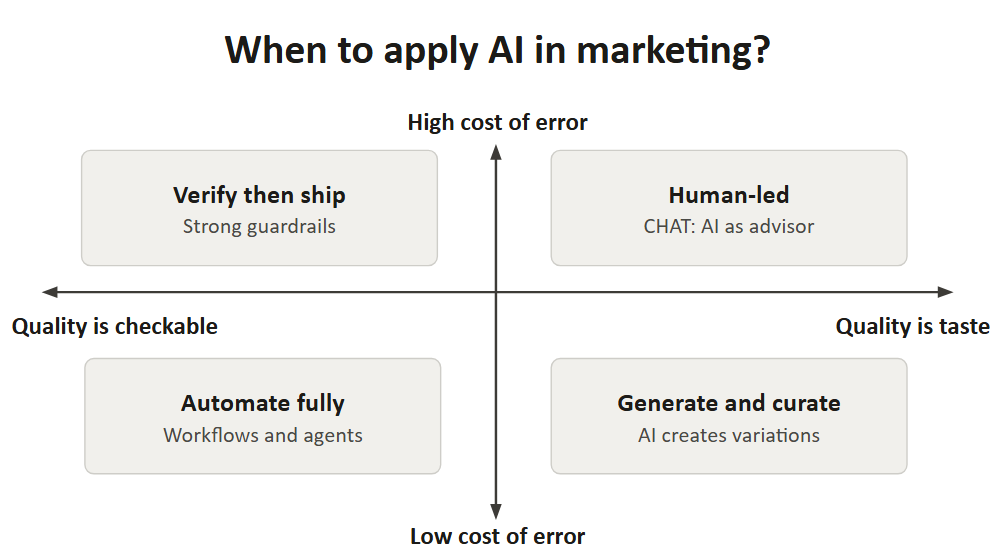
Another way to decide is to think of it in the two axes above: First, how expensive is a mistake? Some errors are a deleted draft. Some spend money or damage the brand before anyone notices.
Second, can a machine check the quality? If you can write down the rules for what “good” looks like, then AI can check its own work. If good means you have to look at it and judge, like an image or a video, then a human has to sit in the loop.
Bottom left: Automate fully
In this quadrant, there is a low cost of error, and the output is checkable. This is where workflows and agents run without you. “At 5pm every day, convert all completed job sheets into CRM records and send the customer an email to ask for a review.” Converting a blog post into social drafts. Turning a five-star review into a reel.
My case-study writer for a facilities maintenance company sits in this quadrant, too. It uses job photos and technician notes to create a draft article waiting in Slack every morning.
Bottom right: Generate and curate
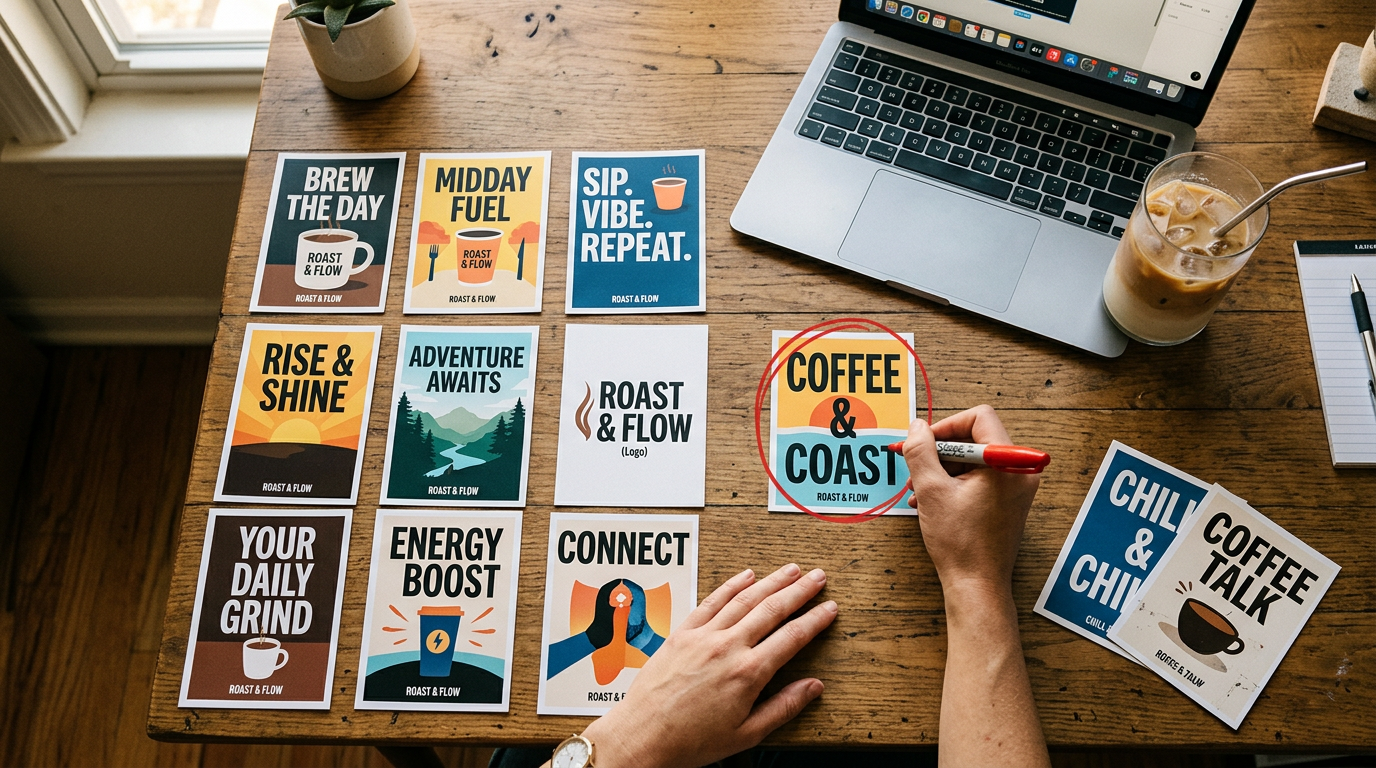
Low cost of error, but the quality is taste. Ad concepts, ad scripts, visual ideas, topic ideas. “10 ad concepts based on ads performance.” “A 30-day content plan based on my Google Search Console history.”
AI can’t tell you which of the 10 concepts is the good one. But generating is cheap, so let it make the variations and you do the picking.
Top left: Verify then ship
High cost of error, but checkable. This is mostly marketing ops: reporting, data analysis, checking the prices and contact numbers in your copy, ad budgets, tracking, bid caps. “Analyse my Google Ads and Meta Ads performance in the last 7 days and suggest 1 action item to improve conversion.”
That exact prompt is now a tool that hands me one action item a week.
Top right: Human-led
High cost of error, and the quality is taste. AI drafts, but somebody has to own it. “Develop a new product launch campaign for my latest retro clothing line.”
Things like coming up with a campaign brief should sit here. Because, if you get it wrong, then everything downstream inherits its mistakes. And only you can decide whether the generated ideas is the right campaign strategy. Brand analysis sits here too. Get the brand wrong and every output that reads it is wrong.
My campaign plugin works in this square. The agent asks the questions and does the research, but I answer them, and I sign off the brief.
Where the grid is only a starting point
There are areas that don’t really sit neatly in the 2×2 grid. For example, a paid ad campaign bid caps and ad budgets. Yes these are machine-checkable, so on paper they belong in “verify then ship” with the AI making the change itself. But I still review every one by hand. A wrong bid can spend tons of money before anyone realises, so it’s wise to avoid giving full wallet control to your AI for now.
So, what marketing tasks have you delegated to AI, and which quadrant does it sit in?
Related:


Leave a Reply